Lacrosse rules and regulations: positions, fouls and formats explained
Two teams use netted sticks to carry, pass and shoot a solid rubber ball into a goal guarded by a goalkeeper, without handling the ball. Play starts with a face-off or a draw, attackers stay outside the circular crease around the goal, and fouls hand the ball to the other side or cost a player time off the field, depending on the format.
Updated · based on the current World Lacrosse rulebooks
- 10 a side in men's field lacrosse
- 4 × 15 minutes in field and box games
- 3 m crease radius, international rules
- 30 s shot clock in box and Sixes
How would you like to learn the rules?
The page below covers the basic rules, the field, the positions, game length, the restart, possession, fouls, the four formats and mixed lacrosse, then closes with a glossary, common questions and the sources. Reading time is about fifteen minutes.
Start with the field and the playersA stepped drawing of the start of play, built from the World Lacrosse rulebooks: where the twenty players stand at a men's face-off and a women's draw, who is released on the whistle, who has to wait for possession, and what happens after an illegal draw. Nine steps, about a minute with Play, or step through at your own pace.
Open the explainer: the face-off and the drawWhat are the basic rules of lacrosse in one minute?
The basic lacrosse rules fit in a few sentences. Two teams use netted sticks to put a solid rubber ball into the other side's goal, and the team with more goals when time ends wins. The ball is carried, passed and shot with the stick, and outfield players may not handle it.
Attackers may not step into the circular crease around the goal. Play starts with a face-off or a draw, and fouls hand the ball to the other side or send a player off for a set time, depending on the format.
The details change with the format. The sections below work through the field, the positions, game length, the restart, the crease and shot clock, fouls, the four formats side by side and mixed lacrosse. The rulebook editions behind each figure are listed in the sources table at the foot, and the rules of the competition being played always take priority.
How big is the team, and what is on the field?
Men's field lacrosse is played ten-a-side. Under World Lacrosse rules, the women's field game allows up to ten players per team on the field at the same time, one of whom may be a goalkeeper; the twelve-a-side game that many people know from television is the US college version. Both field games are played in four 15-minute quarters.
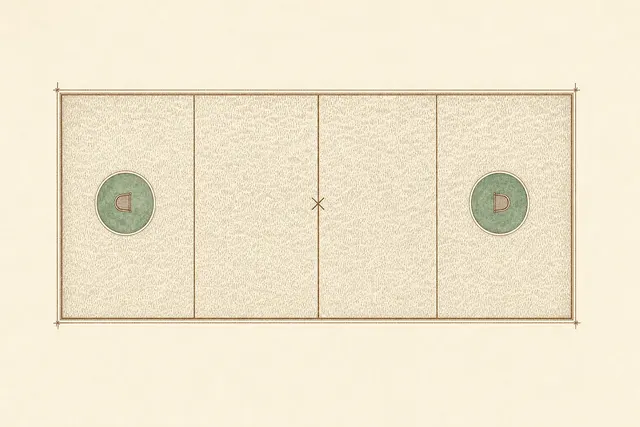
The field is a rectangle divided by lines that matter for the rules. The centre line runs across the middle, with the centre X on it where the face-off is taken in the men's game. A restraining line towards each end separates the attacking and defensive areas from the midfield, and in the men's game it limits how many players may stand in each zone. Wing lines, either side of the centre, mark where midfielders wait during the face-off.
At each end stands a goal: a frame 1.83 m (6 ft) square with a pyramid-shaped net behind it. Around it is the crease, a circle of 3 m radius under international rules, which is the goalkeeper's protected space. The ball is solid rubber in every format, and outfield players may only play it with the stick.
What are the positions in lacrosse?
Field lacrosse groups players into attack, midfield, defence and goal. The names describe where a player spends most of the game, not a fixed spot: midfielders run the length of the field, and every outfield player is expected to catch, pass and pick up loose balls. Women's teams use the same broad groups, and in the indoor and short-sided formats the roles are more fluid still.
| Position | Where they play | Main job | In other formats |
|---|---|---|---|
| Attack | The attacking end, around the opponents' goal | Creating and taking shots; passing from behind and beside the goal | Shared with every outfield player in box and Sixes |
| Midfield | The whole field, end to end | Linking defence and attack; contesting the face-off or draw; carrying the ball through midfield | The basic role in Sixes, where everyone attacks and defends |
| Defence | The defensive end, in front of their own goal | Marking attackers, checking sticks, winning loose balls and starting the clear | Rotates with attack through line changes in box |
| Goalkeeper | The crease | Stopping shots, directing the defence and starting the clear upfield | Present in every format |
Because the zones limit how many players may sit in each end, a team that pushes everyone forward can be penalised. Midfielders are the ones who move between zones, so they cover the most ground.
The goalkeeper is the one position fixed to a place. Under World Lacrosse rules the women's game allows one of the ten players on the field to be a goalkeeper, and the England Lacrosse mixed rules go further: a team may play without one. Box lacrosse and Sixes both field a goalkeeper as one of six.
How long is a lacrosse game in each format?
The question of how long is a lacrosse game has one common answer for the field and box formats: four periods of 15 minutes, which is 60 minutes of playing time. Sixes changes the answer to how long is a lacrosse game, with a shorter figure given below. Men's and women's field lacrosse under World Lacrosse rules both use it, and the older women's pattern of two 30-minute halves is out of date.
| Format | Periods | Playing time |
|---|---|---|
| Men's field | 4 × 15 min | 60 min |
| Women's field | 4 × 15 min | 60 min |
| Box | 4 × 15 min | 60 min |
| Sixes | 4 × 8 min | 32 min |
Sixes is shorter: four eight-minute quarters, played with a 30-second shot clock. It is the format on the Olympic programme for 2028, covered on the Olympics page.
The mixed field rules published by England Lacrosse use a running clock only and allow tied games. The mixed lacrosse section below sets out the rest of that format.
How does play start? The face-off and the draw
Every quarter, and the restart after every goal, begins with a contest for the ball. The two field games solve it in different ways, and the difference says a lot about each game.
- The face-off. In men's field and box lacrosse, two players crouch either side of the centre X with the ball placed between the backs of their stick heads. On the whistle, each tries to clamp, push or flick the ball to a teammate.
- The wing players. In the men's field game, midfielders wait on the wing lines and break towards the ball as soon as it is contested, so a face-off is often won by the wings and not by the two players in the middle.
- The draw. The women's game uses the draw: the ball is held between two raised sticks, back to back, and the umpire's signal sends it into the air, where the nearest players compete to catch it.
Winning the restart matters more in lacrosse than in most field sports, because possession is hard to win back once a team has it. Coaches treat it as a skill of its own, and many men's teams have face-off specialists.
How do possession, the crease and the shot clock work?
Once a team has the ball, it carries it forward by running with it cradled in the pocket or by passing. Defenders may try to dislodge it with stick checks; how much body contact is allowed depends on the format, with the women's game the most restrictive.
The crease
The crease is the circle around each goal, 3 m in radius under international rules. Attacking players may not step into it, so shots are taken from outside its edge. The goalkeeper is protected inside it, and defenders use its line as a reference point for their shape. When a goalkeeper saves a shot or collects a loose ball, the team clears it upfield, often by passing out to a defender on the wing.
The shot clock
Box lacrosse and Sixes both use a 30-second shot clock: a team must shoot within that time or give the ball away. It keeps attacks short and the score moving, and it is the main reason the indoor and short-sided games feel faster than the field game.
Possession also changes when the ball goes out of bounds. How it is returned depends on the format and the situation.
The field games have their own clock in the current World Lacrosse rulebooks: 80 seconds in men's field lacrosse from 1 January 2026, and 80 seconds in the women's field game at World Lacrosse events from 1 January 2027.
What equipment do the rules require?
Two items define the game: the stick and the ball. The stick has a netted head, called the pocket, that holds the ball, and every outfield player carries one. The England Lacrosse mixed rules allow only women's sticks in domestic play.
The ball is solid rubber, about 20 cm round and weighing 142 to 149 g. The men's rules call for a white or orange rubber ball, while the women's and Sixes rules specify a solid, smooth elastomer ball. The goal is the same 1.83 m square in the field games and Sixes, and each rulebook sets out the exact requirements for sticks, goals and protective equipment, so a player buying kit should check the edition for the format they will play.
Which fouls are penalised, and what are the penalties?
Every set of lacrosse rules grades offences by how serious they are, and the punishment follows the grade. The broad shape is the same across the formats even where the detail differs.
Minor, procedural offences, such as breaking the zone limits, interfering with an opponent away from the ball or handling the ball, usually give the other team possession. If the offending side already had the ball, it simply loses it; if not, play restarts with the ball given to the other side.
More serious offences, above all dangerous stick checks, contact to the head and body contact the rules do not allow, bring a time penalty in the men's field game, box and Sixes: the player leaves the field for a set period and the team plays a player short. The women's game handles contact more strictly and restarts most fouls with the fouled player given the ball near the spot of the offence. Players can be cautioned or sent off for dangerous or repeated fouls.
Contact is the clearest difference between the field games. Stick checks are part of every format, how much body contact is legal varies, and the women's game is the most restrictive: barging, charging, blocking and pushing are all fouls there.
Umpires and referees can also let play continue when stopping it would punish the team that was fouled. The exact lists and penalty times are set in each rulebook and are revised from edition to edition, so this page keeps to the principles.
Who writes the rules, and which edition applies?
World Lacrosse publishes a separate rulebook for each of the four formats: the men's field rules for 2025-27, the women's field rulebook for 2025-26, the box rulebook (2024 edition) and the Sixes rule book for 2026-28. Each is revised on its own cycle, so a figure in one edition may not hold in the next.
England Lacrosse, which runs the sport in England, adopted the World Lacrosse women's rulebook for domestic competition and publishes its own variations for mixed play on its rules page. Competitions with their own regulations, such as university or league fixtures, can add to those documents, so the version named in the fixture details is the one that decides a question on the day.
How do the rules change between the four formats?
The four formats share the stick, the ball and the crease, but change the numbers that shape a game: team size, space, time and the shot clock. The lacrosse rules for each one come from its own World Lacrosse rulebook.
| Rule | Men's field | Women's field | Box | Sixes |
|---|---|---|---|---|
| Players | 10 a side | Up to 10 a side (12 in US college) | 6 on the floor | 6 a side, 5 + goalkeeper |
| Playing area | Outdoor field | Outdoor field | Indoor rink inside dasher boards | Outdoor pitch, 70 × 36 m |
| Game length | 4 × 15 min | 4 × 15 min | 4 × 15 min | 4 × 8 min |
| Shot clock | 80 s (from 2026) | 80 s (World Lacrosse events from 2027) | 30 seconds | 30 seconds |
| Restart | Face-off | Draw | Face-off | Set by the Sixes rules |
Sixes is the format built for the Olympic programme: lacrosse returns at the Los Angeles Games in July 2028 in Sixes, for men and women. Box lacrosse is the professional indoor game played in North America. In the UK, club and university lacrosse is played mostly in the two field formats, and the club finder lists where to play.
Two of the formats carry numbers worth knowing. Sixes is played by five outfield players and a goalkeeper on a pitch of 70 m by 36 m, with a 3 m crease and the full 1.83 m goal; events that are not sanctioned by World Lacrosse may use a pitch anywhere from 55 to 75 m long and 35 to 55 m wide. Box lacrosse is played inside dasher boards between about 1.07 m and 1.22 m high (3 ft 6 in to 4 ft), which enclose the rink.
Mixed lacrosse is not a fifth World Lacrosse format. It is a variation of the women's field game, set out in its own section below.
How is mixed lacrosse played in England?
Mixed lacrosse is a field format for teams of men and women. England Lacrosse publishes its Mixed Lacrosse Field Rules 2025 as a list of variations on the World Lacrosse Women's Rule Book 2025-26, which it adopted for domestic competition, so the women's rulebook supplies everything the variations do not change.
The game is played on a World Lacrosse unified pitch with the women's markings. Goals are standard full-size goals, although collapsible "rage cage" goals may be used. The ball may be any solid, smooth elastomer ball. A squad can have up to 18 players, with up to ten on the pitch; one of them may be a goalkeeper, and a team may play without one.
| Rule | Mixed lacrosse |
|---|---|
| Squad | Up to 18 players |
| On the pitch | Up to ten, one of whom may be a goalkeeper; no goalkeeper is allowed as an option |
| Gender mix | At most five of either gender when all participants identify as cisgender; otherwise at least one male and one female and at most five of each |
| Sticks | Any women's crosse; men's heads and shafts are not permitted |
| Clock | Running clock only; tied games are permitted |
| Umpires | At least a Level 1 Women's Umpire qualification and a pass in the Annual Rules Test |
The gender mix is the distinctive rule. When every participant identifies as cisgender, a team may have at most five players of either gender on the field. In every other case a team needs at least one male and one female player and at most five of each. Substitutions may swap genders, provided those minimums still hold.
Only women's sticks are legal in domestic competition, so any women's crosse will do and men's heads or shafts may not be used. That keeps the equipment the same for every player on the pitch.
All the women's minor and major fouls apply, with tougher penalties for the dangerous ones. Rough or dangerous checks, checks to the head and deliberate physical fouls (barging, charging, blocking and pushing) carry a mandatory yellow card. At England Lacrosse events the umpires must hold at least a Level 1 Women's Umpire qualification and pass the Annual Rules Test.
World Lacrosse says it endorses rules developed for wheelchair and mixed lacrosse. At any other organiser's event, that organiser's own rules document is the one that applies, and a club running mixed sessions will normally say which one it uses. The club finder lists clubs, and England Lacrosse publishes its rules and regulations for events it runs.
Lacrosse rules glossary
The words that come up most often when the rules are explained, in alphabetical order.
- Box lacrosse
- The indoor format, six on the floor, played on a rink inside dasher boards.
- Clear
- Moving the ball from the defensive end into attack after a save or a turnover.
- Cradle
- The rocking movement of the stick that keeps the ball in the pocket while running.
- Crease
- The circle around the goal, 3 m in radius under international rules; the goalkeeper's space.
- Draw
- The restart in the women's game, with the ball sent up from between two raised sticks.
- Face-off
- The restart in men's field and box lacrosse, contested by two crouching players at the centre.
- Ground ball
- A loose ball on the ground, scooped up with the stick.
- Mixed lacrosse
- The field format for teams of men and women, played under England Lacrosse's variations on the women's rules.
- The netted part of the stick head, where the ball is held.
- Restraining line
- The line towards each end that separates the attacking and defensive areas from the midfield.
- Shot clock
- The time a team has to shoot; 30 seconds in box lacrosse and Sixes.
- Sixes
- The six-a-side outdoor format on a 70 × 36 m pitch, chosen for LA28.
- Wing line
- The short line either side of the centre where midfielders wait at the face-off.
Lacrosse rules: common questions
How many players are on a lacrosse team?
Men's field lacrosse is ten-a-side. Under World Lacrosse rules a women's team may have up to ten players on the field, one of whom may be a goalkeeper, while US college games use twelve. Box lacrosse and Sixes are both six-a-side.
How long is a lacrosse game?
Men's and women's field lacrosse and box lacrosse are played in four 15-minute quarters under the international rules. Sixes is shorter, with four 8-minute quarters.
Is lacrosse a contact sport?
It depends on the format. Stick checks are part of every format and the amount of legal body contact varies, with the women's game the most restrictive. Dangerous checks and contact to the head are penalised in all of them.
How do men's and women's lacrosse rules differ?
Men's field lacrosse starts with a face-off and is played ten-a-side; the women's game starts with a draw and allows up to ten players under World Lacrosse rules. Both use four 15-minute quarters, and the women's game restricts contact more tightly.
What is box lacrosse?
Box lacrosse is the indoor format, played six-a-side (five runners and a goalkeeper) on a rink enclosed by dasher boards. Games are four 15-minute periods with a 30-second shot clock.
What is Sixes?
Sixes is six-a-side lacrosse (five outfield players and a goalkeeper) on a 70 m × 36 m pitch, with a 30-second shot clock and four eight-minute quarters. It is the format chosen for the 2028 Olympic Games.
What is mixed lacrosse?
Mixed lacrosse is a field format for teams of men and women. England Lacrosse's rules cap each gender at five players on the field, allow only women's sticks, use a running clock and apply the women's fouls with tougher penalties for dangerous play.
Can you touch the ball with your hands in lacrosse?
Outfield players may not play the ball with their hands; everything goes through the stick. What the goalkeeper may do inside the crease is set out in each format's rulebook.
Where these facts come from
| Source | What it supports | Checked |
|---|---|---|
| World Lacrosse, Men's Rules 2025-27 | Ten-a-side, four 15-minute periods, 1.83 m goal, 3 m crease, face-off | 3 November 2026 |
| World Lacrosse, Women's Field Rulebook 2025-26 | Up to ten players, one may be a goalkeeper; four 15-minute quarters; the draw; 3 m goal circle | 3 November 2026 |
| World Lacrosse, Box Rulebook 2024 | Six on the floor, dasher boards, four 15-minute periods, 30-second shot clock | 3 November 2026 |
| World Lacrosse, Sixes Rule Book 2026-28 | Six-a-side, 70 m × 36 m pitch, four eight-minute quarters, 30-second shot clock | 3 November 2026 |
| England Lacrosse, Mixed Lacrosse Field Rules 2025 | Mixed squad and pitch numbers, gender mix, sticks, clock, officials, mandatory cards | 3 November 2026 |
| England Lacrosse, rules | Where the mixed field rules are published; adoption of the World Lacrosse women's rulebook | 3 November 2026 |
| World Lacrosse, playing rules | Endorsement of rules developed for wheelchair and mixed lacrosse | 3 November 2026 |
| IOC, LA28 dates | Los Angeles Games, 14 to 30 July 2028 | 3 November 2026 |
| USA Lacrosse, lacrosse headed to the 2028 Olympics | IOC vote of 16 October 2023 adding lacrosse, in the Sixes format, to LA28 | 4 November 2026 |